Your eye has a clear lens, just like a camera. It can become clouded as a cataract due to age, injury, or other factors.
Normally, a clear lens provides clear vision. A cataract lens blurs, dims, discolors, and clouds one’s vision. Surgery removes this cataract, and replaces it with a small, clear plastic lens.
There are many types of cataracts. In some, only part of the lens is affected, and yet, this can cause a great loss in the quality of vision. As cataracts can develop slowly over a period of time, decreased vision may not be noticed.
Types of cataract
For most cases of cataract removal, a small incision is made in the front part of the eye. The cataract lens is removed using a special ultrasonic probe. The new replacement lens is placed inside the lens bag, which is left intact.
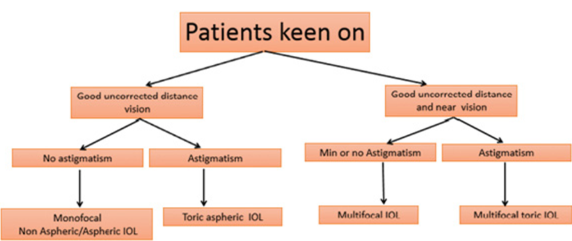
Choosing an IOL is a difficult decision for any patient. The following chart is a simplified way of approaching about the question of which lens to implant
Summary
The computerized cataract ultrasonic system provides total surgeon control of both intraocular pressure and cataract extraction. Other techniques may be used in special cases, and exploration continues for the future. Cataracts mostly affect people over 60 years of age, but they can occur at any age. Most cataract surgeries are an out-patient procedure, taking just a few minutes, and allow a patient to return to most daily activities within a couple of days. Cataract surgery, as with all surgeries, does contain an element of risk which must be fully considered and discussed with your eye care provider.
Important Note
This information is provided for general educational concepts only. Your specific circumstances, conditions, treatment approaches, and results may vary. Additional information and precautions should be discussed with Dr. Swati Agarwal.